

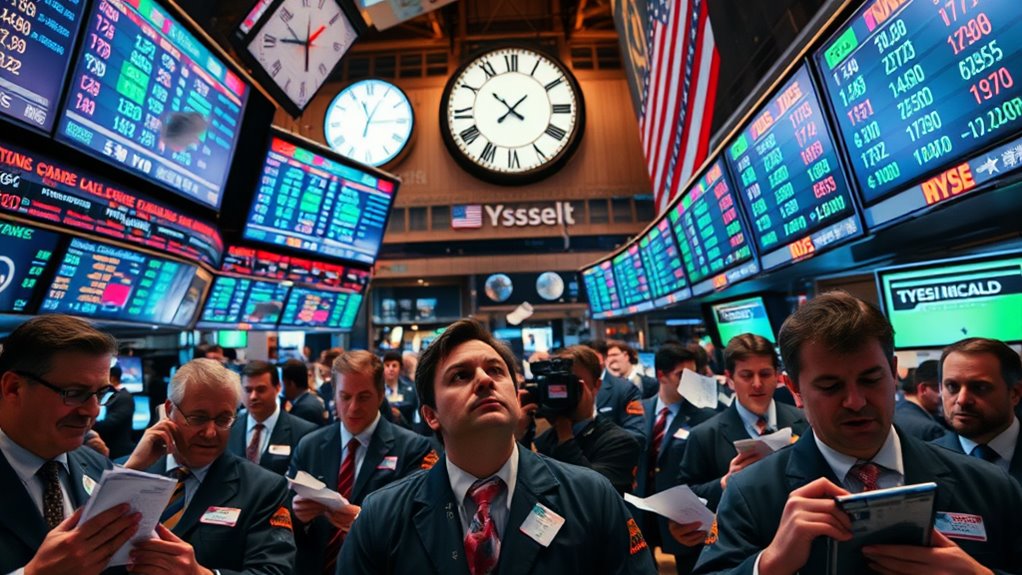
Breaking news substantially impacts financial markets by triggering immediate price fluctuations. Positive headlines often lead to increased buying activity, whereas negative news can provoke panic selling. Psychological reactions, such as fear and greed, greatly influence investor behavior, amplifying market volatility. High-frequency trading further exacerbates this effect, with algorithms executing trades at lightning speed. Comprehending these dynamics is essential for investors. To gain deeper insights into this intricate relationship, further exploration of various strategies and historical case studies is advantageous.
The Role of News in Market Volatility
Although many factors contribute to market volatility, breaking news often serves as a catalyst that can amplify price fluctuations. News sentiment plays a vital role in shaping investors' perceptions and reactions to unfolding events. Positive or negative headlines can trigger immediate buying or selling, leading to sharp shifts in market dynamics. For instance, favorable economic reports may bolster confidence, whereas negative news, such as political instability or corporate scandals, can instigate panic selling.
These reactions can create volatility trends, where markets experience heightened fluctuations in response to ongoing news cycles. Investors closely monitor the news environment, as changes in sentiment can quickly lead to significant price movements. As a result, comprehending the interplay between breaking news and market volatility is fundamental for maneuvering the financial terrain effectively. The ability to gauge the potential impact of news on market behavior can greatly influence investment strategies.
Psychological Reactions to Breaking News
When breaking news surfaces, investors often experience heightened emotional responses that can greatly influence their decision-making processes. Such responses are frequently exacerbated by cognitive biases, leading to irrational behavior. Fear of missing out (FOMO) or panic selling can drive market trends, as investors react impulsively rather than analytically.
| Emotional Response | Impact on Decision-Making | Associated Cognitive Bias |
|---|---|---|
| Fear | Panic selling | Loss aversion |
| Greed | Over-investing | FOMO |
| Optimism | Holding onto stocks | Confirmation bias |
| Anxiety | Avoiding investments | Status quo bias |
These emotional reactions often overshadow fundamental analysis, resulting in volatility. Comprehending these psychological factors is crucial for investors aiming to navigate the turbulent waters of financial markets influenced by breaking news. Recognizing one's own emotional responses can help mitigate the effects of cognitive biases on investment choices.
Economic Indicators and Their Influence
Economic indicators serve as critical signals for market participants, influencing their reactions to breaking news. The timing of these indicators' release can amplify or mitigate market volatility, depending on investor sentiment at that moment. Comprehending the correlation between economic data and market responses can provide valuable insights into financial trends.
Market Reactions to News
Market reactions to news are often shaped by the release of key economic indicators, which serve as fundamental signals for investors and analysts alike. These indicators, such as employment rates, inflation figures, and GDP growth, provide critical insights into the overall health of the economy. When significant data is reported, it can lead to immediate and sometimes volatile market movements, reflecting the news impact on investor sentiment. Traders closely monitor these releases to optimize market timing, aiming to capitalize on price fluctuations that often follow. As a result, comprehending the relationship between economic indicators and market reactions is imperative for making informed investment decisions, as timely responses can greatly influence financial outcomes in a swiftly changing environment.
Indicator Release Timing
The timing of economic indicator releases greatly influences market dynamics. Investors closely watch these releases, as they can considerably impact trading decisions and market sentiment. The importance of each indicator can vary based on its release frequency and the current economic climate.
- Monthly Reports: Indicators such as employment and inflation are released monthly, providing timely insights into economic health.
- Quarterly Updates: GDP and corporate earnings reports are released quarterly, offering a broader perspective on economic trends.
- Annual Assessments: Yearly indicators, like trade balances, help shape long-term investment strategies.
Understanding the timing and importance of these indicators allows investors to better navigate the financial environment, making informed decisions in response to market movements.
Correlation With Investor Sentiment
Investor sentiment plays a pivotal role in shaping financial markets, particularly in response to economic indicators. Changes in investor behavior often reflect broader market perceptions influenced by news releases. For instance, positive economic data can promote optimism, leading to increased investments, during negative indicators may trigger fear, resulting in sell-offs. Sentiment analysis serves as a tool for comprehending these reactions, as it gauges the emotional responses of investors to breaking news. By analyzing trends in sentiment, market participants can better anticipate shifts in investor behavior, enabling them to make informed decisions. As a result, the correlation between economic indicators and investor sentiment underscores the dynamic relationship that drives market fluctuations, highlighting the importance of real-time information in investment strategies.
High-frequency Trading and News Algorithms
High-frequency trading relies on sophisticated algorithms that execute trades at remarkable speeds, often in response to breaking news. This rapid execution can considerably affect market volatility, as large volumes of trades are triggered almost instantaneously. As a result, algorithmic trading strategies must continuously adapt to the unpredictable nature of news events to maintain effectiveness.
Speed of Execution
Though traditional trading strategies often rely on human intuition and analysis, the rapid evolution of technology has ushered in an era where speed is paramount. High-frequency trading and news algorithms exemplify this shift, emphasizing the importance of speed analysis in executing trades. As traders utilize real-time data, they face various execution risks that can greatly impact their financial outcomes.
- Instantaneous response to breaking news events.
- Algorithms that evaluate and act on market data within milliseconds.
- The potential for increased volatility as a result of rapid buy/sell actions.
In this fast-paced environment, comprehending the dynamics of speed and execution is critical for traders aiming to capitalize on fleeting market opportunities whilst mitigating associated risks.
Market Volatility Effects
As market participants increasingly rely on high-frequency trading and sophisticated news algorithms, the relationship between breaking news and market volatility becomes ever more pronounced. These technologies enable traders to react to news events within milliseconds, often amplifying market trends in unpredictable ways. When significant news breaks, algorithms analyze data and execute trades at speeds unattainable by human traders, leading to rapid price fluctuations. This heightened volatility complicates risk management, as market participants must navigate a terrain where prices can shift dramatically in response to real-time information. As a result, comprehending how news influences market dynamics is crucial for developing effective strategies to mitigate risk and capitalize on emerging trends.
Algorithmic Trading Strategies
Algorithmic trading strategies have transformed the way financial markets operate, particularly through the use of high-frequency trading and advanced news algorithms. These methods leverage algorithmic decision making to capitalize on market movements driven by breaking news. Key elements of these strategies include:
- High-frequency trading: Executes numerous orders per second, exploiting minute price changes.
- News sentiment analysis: Processes vast amounts of news data to gauge market sentiment and predict price movements.
- Market prediction models: Utilize historical data and real-time information to anticipate future trends.
Case Studies: Historic Market Reactions
When significant breaking news occurs, financial markets often react with remarkable volatility, reflecting the immediate impact of new information on investor sentiment and decision-making. Historical events such as the September 11 attacks and the 2008 financial crisis serve as prime examples of this phenomenon. Following the 9/11 attacks, markets experienced a sharp decline, with the Dow Jones Industrial Average plummeting over 600 points in a single day. This illustrates how fear and uncertainty can drive swift market responses. Similarly, during the 2008 financial crisis, the announcement of major bank bailouts led to intense fluctuations, showcasing how news regarding systemic risks can alter investor confidence dramatically. These case studies highlight the profound influence that breaking news has on financial markets, emphasizing the need for investors to remain vigilant and informed amidst the chaos of swiftly changing information.
Strategies for Investors in a News-driven Environment
Steering a news-driven environment requires investors to adopt strategic approaches that mitigate risks and capitalize on opportunities. Investors can navigate the intricacies of breaking news by employing the following strategies:
- News Diversification: Investors should diversify their news sources to avoid information overload. This practice guarantees a more balanced perspective on market developments.
- Sentiment Analysis: Utilizing sentiment analysis can help investors gauge market reactions to news events, informing tactical allocation decisions that align with prevailing market sentiment.
- Event-Driven Investing: Focusing on event-driven investing allows investors to capitalize on specific news events during the implementation of robust risk management techniques to safeguard against potential losses.
Frequently Asked Questions
How Do Different Types of News Affect Various Sectors Differently?
Different types of news can greatly influence various sectors in distinct ways. Earnings reports often sway investor sentiment, with positive results boosting stock prices in respective industries whereas negative outcomes can lead to declines. Regulatory changes, conversely, can create uncertainty or opportunity, particularly in sectors like healthcare and finance. Companies may face new compliance costs or benefit from deregulation, affecting their operational strategies and overall market performance.
What Is the Role of Social Media in Breaking News Impact?
In the digital age, social media serves as a lightning rod for news dissemination, delivering real-time updates that can shape market sentiment. As information overload becomes commonplace, investors often find themselves steering through a torrent of opinions and headlines, which can distort their behavior. The immediacy of social media amplifies the effects of breaking news, making it a formidable force that influences how quickly and deeply news resonates across various sectors.
How Do Geopolitical Events Influence Global Financial Markets?
Geopolitical events considerably influence global financial markets by creating uncertainty and market volatility. When geopolitical tensions arise, investors often react by reallocating their portfolios, seeking safer assets such as gold or government bonds. This reaction can lead to fluctuations in stock prices and currency values, as market participants gauge the potential impact of these events on economic stability. As a result, geopolitical developments can drive rapid changes in market dynamics, affecting investor behavior and confidence.
Are There Specific Times When News Impacts Markets More Significantly?
Market volatility often escalates during specific times when news cycles generate heightened awareness. Events such as economic reports, political announcements, or natural disasters can trigger significant reactions from investors. These critical moments can lead to abrupt price movements as traders swiftly adjust their positions in response to new information. As a result, grasping the timing and nature of news cycles is vital for predicting when markets may experience more pronounced fluctuations as a result of external events.
How Can Retail Investors React Quickly to Breaking News?
In the busy marketplace of finance, where information flows like rushing water, retail investors can utilize the strength of news alerts to navigate swift currents. By setting up timely notifications, they can quickly absorb critical updates and adapt their trading strategies accordingly. This proactive approach allows them to seize fleeting opportunities, transforming the chaos of breaking news into a well-charted course, ultimately enhancing their potential for informed decision-making and effective market participation.