

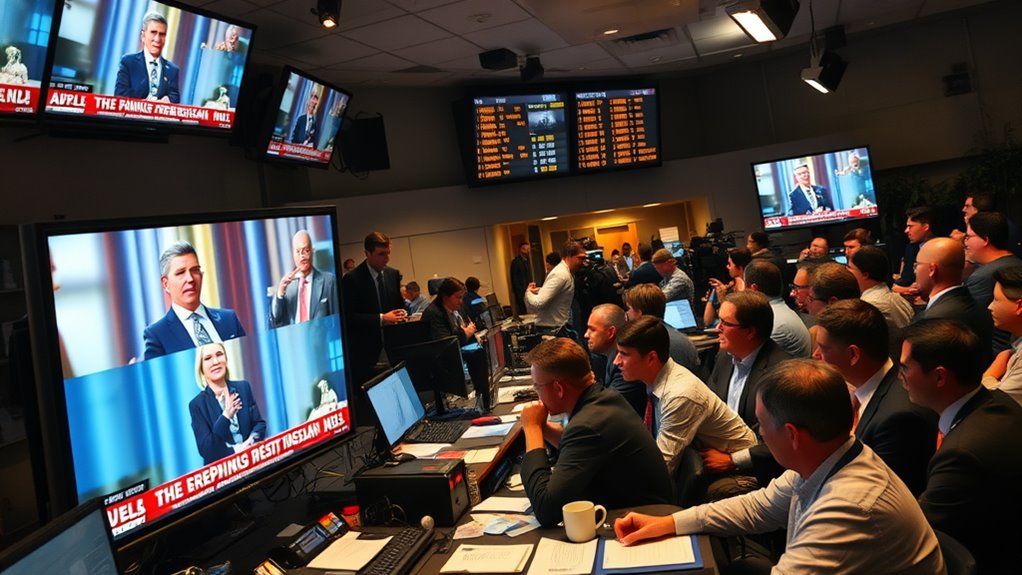
News coverage plays an essential role in shaping elections and public policy. Media narratives influence how events, candidates, and policies are perceived. Coverage bias often raises some candidates, overshadowing others, impacting voter opinions and decisions. Moreover, the influence of framing affects public interpretation of important issues. This dynamic environment is further complicated by social media, which customizes news consumption. Comprehending these factors offers key insights into their implications for democracy and civic engagement.
The Role of Media in Shaping Public Opinion
As the terrain of news media evolves, its influence on public opinion becomes increasingly pronounced. Media narratives play an important role in shaping how events, policies, and candidates are perceived by the public. Through selective reporting and framing, media outlets can highlight specific aspects of a story, thereby guiding public perception. For instance, the portrayal of political candidates can greatly affect voter attitudes, often determining which attributes are emphasized and which are downplayed.
This shaping of public opinion can occur through various channels, including television, print, and digital platforms. In an age where information is readily accessible, the speed and manner in which news is disseminated can alter perceptions almost instantaneously. As a result, grasping the role of media narratives is vital for comprehending how public opinion forms and shifts, influencing electoral outcomes and eventually affecting democratic processes.
Coverage Bias and Its Impact on Candidate Visibility
Even though media coverage is intended to provide balanced information about all candidates, coverage bias can greatly skew the visibility of certain individuals over others. This bias often results from media favoritism, where particular candidates receive disproportionate attention. Such imbalances can severely affect candidate representation, influencing public perception and electoral outcomes.
| Candidate Name | Coverage Volume |
|---|---|
| Candidate A | High |
| Candidate B | Medium |
| Candidate C | Low |
As shown in the table, Candidate A garners markedly more coverage than Candidates B and C. This disparity can create a false sense of popularity or viability, leading voters to favor more visible candidates, regardless of their actual platforms. As a result, the nuances of less-covered candidates may go unnoticed, eventually shaping public discourse and policy decisions in favor of those who dominate the media environment.
The Influence of Social Media on News Consumption
As traditional news outlets have historically shaped public discourse, social media now plays a pivotal role in how individuals consume news. The rise of social media platforms has transformed news consumption through various mechanisms. Algorithmic bias influences which content is prioritized, often leading to audience segmentation and the creation of echo chambers. These dynamics can improve engagement metrics but likewise facilitate misinformation spread.
Key influences of social media on news consumption include:
- Content curation: Users receive customized news feeds based on their preferences.
- User generated content: Individuals contribute to the news environment, challenging traditional sources.
- Engagement metrics: Platforms promote stories that generate the most interaction, sometimes at the expense of accuracy.
- Echo chambers: Users are often exposed to information that reinforces their existing beliefs, limiting diverse perspectives.
This complex interplay shapes public comprehension and engagement with current events, eventually affecting elections and public policy.
Investigative Journalism and Its Effect on Policy Issues
Investigative journalism plays an essential role in shaping public discourse by uncovering hidden truths and bringing significant policy issues to light. By informing citizens, it improves public awareness and nurtures a more informed electorate. Furthermore, its findings often hold government officials accountable, influencing policy decisions and promoting transparency.
Role of Investigative Journalism
When examining the terrain of modern journalism, the role of investigative reporting emerges as a crucial component in shaping public policy. Investigative journalism utilizes rigorous investigative techniques to uncover truths often hidden from the public eye. This commitment to revealing facts encourages transparency and accountability in governance.
Key aspects of investigative journalism include:
- Uncovering corruption and malfeasance
- Highlighting systemic issues affecting communities
- Holding public officials accountable
- Promoting informed citizen engagement
Impact on Public Awareness
The influence of investigative journalism extends beyond merely exposing corruption; it plays a significant role in shaping public awareness of critical policy issues. By uncovering hidden truths and presenting complex topics in an accessible manner, investigative journalism encourages informed public discourse. This engagement motivates citizens to explore diverse viewpoints, eventually enhancing their comprehension of pressing matters. Additionally, a robust commitment to media literacy empowers the public to critically evaluate information sources, distinguishing between credible reporting and sensationalism. As investigative journalism highlights systemic problems, it motivates citizens to demand accountability and reform, thereby influencing policymakers. In this way, the work of investigative journalists serves as a catalyst for informed dialogue, ensuring that crucial policy issues remain at the forefront of public consciousness.
Accountability in Government Actions
How can investigative journalism serve as an important mechanism for holding government officials accountable? Investigative journalism plays a significant role in promoting government transparency and ensuring media accountability. By uncovering hidden facts and exposing misconduct, journalists shed light on the actions of public officials, encouraging an informed citizenry that demands accountability.
- Investigative reports often lead to policy changes.
- They help identify and rectify systemic issues.
- They encourage public engagement in governance.
- They can deter corruption through scrutiny.
Through rigorous investigation and reporting, the media acts as a watchdog, compelling government officials to act in the public's best interest. In the end, this accountability is fundamental for a healthy democracy, enabling citizens to hold their leaders responsible for their actions.
The Power of Framing: How Stories Are Told
The framing of news stories plays a vital role in shaping public perception during elections. Language choice, visual imagery, and the selective highlighting of certain narratives can greatly influence how events and candidates are viewed. Comprehending these elements is fundamental for analyzing the impact of media coverage on electoral outcomes.
Influence of Language Choice
Even though the choice of language in news coverage may seem like a minor detail, it particularly shapes public perception and comprehension of political events. Language manipulation plays a critical role in framing narratives, influencing how audiences interpret facts. The emotional resonance of specific word choices can evoke strong feelings, swaying public opinion.
- Words like "crisis" versus "challenge" can alter urgency perception.
- Describing a policy as "reform" may suggest positive change.
- Referring to opponents as "radicals" can instill fear.
- The use of inclusive language may cultivate a sense of community.
These linguistic strategies not only inform but likewise persuade, emphasizing the significant impact of language on electoral outcomes and public policy decisions.
Visual Imagery's Impact
Although language shapes narratives, visual imagery in addition plays a crucial role in framing political stories and influencing public perception. Images used in news coverage often carry strong visual symbolism, which can evoke intense emotions and shape viewers' attitudes. For instance, a photograph of a politician engaging with constituents can promote feelings of connection and trust, whereas contrasting images of unrest may generate fear or concern. This emotional resonance is vital; it affects how individuals interpret political events and policies. By selecting specific visuals, media outlets guide audiences toward particular interpretations, reinforcing or challenging existing beliefs. In the end, the strategic use of visual imagery not just frames political narratives but also greatly impacts public engagement and electoral outcomes.
Selective Story Highlighting
As news outlets endeavor for objectivity, the selective highlighting of stories greatly influences public perception and grasp of political events. This practice can shape narratives, allowing for narrative control that affects voter opinions and policy discussions. By focusing on certain issues during downplaying others, media organizations can unintentionally engage in media censorship, filtering what audiences perceive as important.
- Emphasis on scandal over substance
- Coverage disparities between candidates
- Highlighting specific voter demographics
- Ignoring significant but less sensational issues
These choices not only impact electoral outcomes but likewise frame public discourse, demonstrating the influence of framing in shaping the political environment. Comprehending this phenomenon is vital for discerning how information is presented and its subsequent effects on democracy.
Voter Engagement and the Accessibility of Information
Voter engagement is heavily influenced by the accessibility of information, which can either empower citizens or hinder their participation in the electoral process. Effective voter education relies on clear and easily accessible information about candidates, policies, and voting procedures. When citizens can readily obtain this information, they are more likely to feel informed and motivated to participate in elections. Conversely, barriers such as complex language, limited availability, or misinformation can frustrate potential voters and lead to disengagement.
Moreover, the rise of digital media has transformed the environment of information accessibility, allowing for greater dissemination of knowledge. Nevertheless, it also poses challenges, as not all sources provide accurate or unbiased information. Consequently, ensuring equitable access to reliable information is vital for nurturing an engaged electorate. Ultimately, enhancing voter education and improving information accessibility are fundamental steps toward promoting active participation in the democratic process.
The Relationship Between News Coverage and Election Outcomes
The relationship between news coverage and election outcomes is a critical area of study, as media narratives can greatly shape public perception and influence voter behavior. Coverage accuracy and the framing of issues can directly impact polling influence, guiding voters' decisions and preferences.
Key aspects to reflect on include:
- Media framing: How issues are presented can alter public interpretation.
- Polling influence: Reports on polls can create a bandwagon effect, swaying undecided voters.
- Coverage accuracy: Misinformation or biased reporting can distort voters' comprehension of candidates and policies.
- Candidate visibility: Increased media exposure can improve a candidate's appeal and perceived viability.
Grasping this relationship is vital for comprehending how news can affect electoral outcomes, as the information disseminated through various media channels plays a pivotal role in shaping voter attitudes and actions during elections.
Ethical Considerations in Political Reporting
During the process of steering through the intricacies of political reporting, journalists must grapple with a range of ethical considerations that greatly affect their work. Adhering to ethical standards is essential, as it guarantees that information is presented fairly and accurately. Journalists face the challenge of balancing the need for compelling narratives with the imperative to maintain objectivity. Misrepresentation or sensationalism can undermine public trust and distort the democratic process.
Moreover, journalistic integrity is significant in cultivating accountability among political figures. Reporters must be vigilant in fact-checking and verifying sources to avoid spreading misinformation. Ethical dilemmas also arise when journalists navigate conflicts of interest, as personal biases can inadvertently shape coverage. In the end, the commitment to ethical standards and journalistic integrity not just guides journalists in their reporting but additionally plays an indispensable role in shaping public perceptions and influencing electoral outcomes.
Frequently Asked Questions
How Do News Outlets Choose Which Stories to Cover During Elections?
During a heated election, a news outlet may prioritize covering a candidate's controversial statement over a less sensational policy proposal. This story selection aligns with editorial priorities that seek to engage viewers and drive ratings. Editors often consider factors such as public interest, potential impact, and the competitive environment when choosing stories. In the end, these decisions shape the narrative surrounding elections, influencing voter perceptions and comprehension of the candidates and their platforms.
What Role Do Fact-Checkers Play in Political News Coverage?
Fact-checkers play an essential role in political news coverage by ensuring the accuracy of information disseminated to the public. Their fact checking process involves verifying statements made by politicians and other public figures, helping to combat misinformation that can mislead voters. By providing clear assessments of claims, fact-checkers contribute to a more informed electorate, encouraging accountability and transparency in political discourse, ultimately improving the quality of public debate.
How Can Voters Identify Biased News Sources?
Identifying biased news sources can be like traversing a dense forest; one must be vigilant to avoid hidden pitfalls. Voters can improve their news literacy by critically evaluating the language used in articles, looking for emotionally charged words that indicate bias. Moreover, cross-referencing multiple sources helps in bias detection, as differing viewpoints can reveal underlying agendas. Engaging with media literacy resources further empowers individuals to discern credible information amidst the noise.
What Impact Does Celebrity Endorsement in News Have on Elections?
Celebrity endorsements can greatly shape voter perception during elections. Their influence often transcends traditional political messaging, as many voters may trust or admire these public figures. This can lead to increased visibility for candidates and sway undecided voters, as celebrities often embody relatable values or aspirations. Nevertheless, the extent of this impact varies, with some voters remaining skeptical of celebrity influence, whereas others may be swayed by their endorsements, altering the electoral environment.
How Do Political Campaigns Respond to Negative News Coverage?
Political campaigns often face the challenge of negative news coverage, prompting a strategic response. Whereas some campaigns may resort to aggressive negative messaging to counter criticism, others focus on damage control, aiming to reframe narratives positively. Juxtaposing these approaches illustrates the tension between aggression and diplomacy. In the end, campaigns assess the severity of coverage, deploying tactics that may include public relations efforts, social media engagement, or targeted advertisements to mitigate potential damage and restore public perception.