

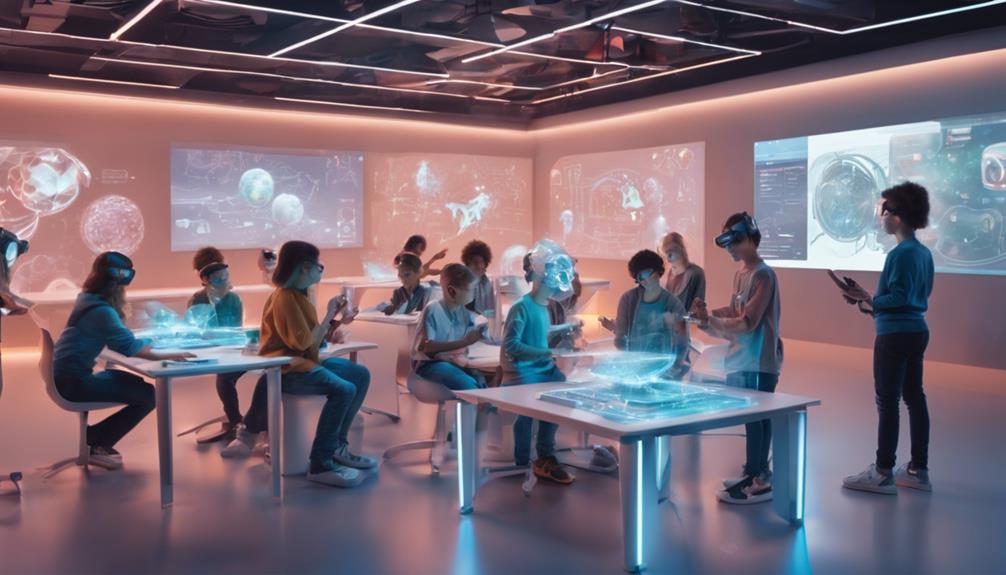
The future of education is undergoing a significant transformation, driven by technological advancements that prioritize personalized, immersive, and adaptive learning experiences. By 2025, online education will become the norm, with AI-powered systems catering to individual learning styles and needs. Virtual reality will enable interactive and engaging learning, whilst real-time feedback and assessment will transform the classroom. The focus will shift from traditional teaching methods to skills training for the future, equipping students with adaptable skills to thrive in an ever-changing job market. As tech-driven learning continues to evolve, the possibilities for growth and innovation will only continue to unfold.
Revolutionizing the Learning Experience
By 2025, experts predict that at least 50% of all college classes will be taught online, revolutionizing the learning experience for millions of students worldwide. This shift to online education offers students the freedom to learn at their own pace, anytime, and anywhere. Online courses provide unparalleled flexibility, allowing students to balance their academic pursuits with other responsibilities and interests.
Gamified learning platforms are becoming increasingly popular, making learning more engaging and interactive. These platforms encourage healthy competition, nurturing collaborative study groups that facilitate knowledge sharing and teamwork. Students can participate in virtual discussions, share resources, and work together to achieve common goals. This collaborative approach not only enriches the learning experience but also cultivates essential skills like communication, problem-solving, and critical thinking.
The traditional classroom model is also undergoing a significant transformation. The flipped classroom approach, where students learn course materials at home and work on projects in class, is gaining traction. Project-based assessments, which focus on real-world applications, are replacing traditional exams. This approach enables students to apply theoretical concepts to practical problems, making learning more meaningful and relevant. As online education continues to evolve, it's evident that the future of learning will be more flexible, interactive, and student-centered.
AI-Powered Adaptive Learning Systems
Artificial intelligence is reshaping the education realm with AI-driven adaptive learning systems that cater to individual learning styles, abilities, and needs. These systems are revolutionizing the way students learn by providing personalized learning experiences customized to their unique requirements. With adaptive technology, students can learn at their own pace, accelerating or slowing down as needed, and receiving real-time feedback and evaluations.
AI-driven adaptive learning systems are crafted to identify knowledge gaps and adjust the curriculum accordingly, ensuring that students receive targeted instruction and assistance. This approach enables educators to focus on what matters most – providing guidance, mentorship, and nurturing. By utilizing machine learning algorithms, these systems can analyze vast amounts of data, identifying patterns and trends that guide instruction and enhance student outcomes.
The advantages of AI-driven adaptive learning systems are undeniable. Students experience increased engagement, motivation, and confidence, as they take ownership of their learning voyage. Teachers, meanwhile, can focus on high-touch, high-value activities, such as facilitating discussions, providing feedback, and cultivating a love of learning. As the educational terrain continues to transform, AI-driven adaptive learning systems are positioned to play a pivotal role in shaping the future of education – one that is personalized, flexible, and student-centered. By embracing this technology, we can unleash the full potential of our students, empowering them to succeed in an increasingly intricate and interconnected world.
Virtual Reality in Education
Virtual reality is transforming the way students learn by providing immersive experiences that engage them on a deeper level. It's allowing them to interact with 3D models that simulate real-world environments, making complex concepts more accessible and fun to learn. By leveraging simulation-based training, educators can create personalized learning paths that cater to individual needs and learning styles.
Immersive Learning Experiences
In the field of education, educators are utilizing the potential of immersive learning experiences to transform the way students interact with and absorb complex information. By incorporating gamified learning and sensory engagement, students are more invested in the learning process. This approach stimulates their curiosity, encouraging them to explore and learn through hands-on exploration. Interactive storytelling is another key aspect of immersive learning, allowing students to become an active part of the narrative. This type of experiential learning enables students to develop a deeper comprehension of complex concepts, making them more relatable and memorable. Furthermore, immersive learning experiences provide a safe space for students to experiment, take risks, and learn from their mistakes. As a result, students develop vital skills such as critical thinking, problem-solving, and creativity. By embracing immersive learning experiences, educators can create a more engaging, effective, and enjoyable learning environment that prepares students for success in the 21st century.
Interactive 3D Models
By integrating interactive 3D models into educational curricula, teachers can further enrich immersive learning experiences, allowing students to explore intricate concepts in a highly engaging and interactive environment. This technology enables students to delve deeper into abstract ideas, making them more accessible and easier to grasp. Interactive 3D models can be used to develop interactive simulations, where students can manipulate and experiment with virtual objects, nurturing a deeper comprehension of complex principles. For example, in a physics class, students can utilize 3D modeling to create virtual experiments, testing hypotheses and observing the effects of different variables. This hands-on approach not only boosts student engagement but also enriches their critical thinking and problem-solving abilities. By utilizing interactive 3D models, educators can create a more dynamic and participative learning environment, where students are encouraged to take an active role in their learning process. Consequently, students are better prepared to thrive in an increasingly intricate and competitive world.
Simulation-Based Training
Their educational expedition takes a significant leap forward as students enter simulation-based training, where the boundaries of traditional classroom learning are shattered. With virtual reality, students can engage in hands-on practice, experimenting with intricate concepts in a risk-free environment. This experiential learning approach allows them to explore, create, and innovate without limitations, nurturing a deeper comprehension of abstract ideas.
In simulation-based training, students can engage in authentic scenarios, making decisions and facing consequences in a virtual world. This immersive experience enables them to cultivate critical thinking, problem-solving, and decision-making skills, crucial for success in the real world. By bridging the gap between theory and practice, simulation-based training prepares students for the challenges of the 21st century, empowering them to take charge of their learning expedition. As they navigate through virtual reality, students discover new possibilities, revealing their full potential and igniting a sense of freedom and autonomy in the learning process.
Accessibility and Inclusion Unleashed
Advances in technology have enabled educators to create personalized learning experiences that cater to diverse learning needs, effectively democratizing access to quality education. This shift towards inclusivity has led to the adoption of universal design principles, ensuring that learning materials and tools are accessible to all students, regardless of their abilities. By incorporating features such as text-to-speech functionality, font size adjustment, and high contrast modes, educational platforms can now accommodate diverse learners, including those with disabilities.
This focus on accessibility has also led to the development of innovative tools that support students with specific needs. For instance, AI-powered chatbots can assist students with language barriers or learning disabilities, providing them with real-time support and feedback. Additionally, virtual learning environments can be designed to accommodate students with physical disabilities, allowing them to participate fully in the learning process.
As technology continues to evolve, it's likely that we'll see even more creative solutions emerge to address the needs of diverse learners. By prioritizing accessibility and inclusion, educators can create learning environments that are truly democratic, where every student has an equal opportunity to succeed. This, in turn, can lead to a more inclusive and equitable society, where everyone has the freedom to pursue their full potential.
Real-Time Feedback and Assessment
They're revolutionizing the classroom with instant grading systems that provide students with immediate feedback on their performance. This real-time assessment enables teachers to identify areas where students need extra support, allowing for personalized progress tracking and more targeted instruction. By leveraging technology to streamline the evaluation process, educators can focus on what matters most: helping students learn and grow.
Instant Grading Systems
Nearly 90% of educators agree that timely feedback is important for student success, which is why instant grading systems, capable of providing real-time feedback and assessment, have become a critical component of modern education. These systems automate the grading process, freeing instructors from tedious and time-consuming tasks, and enabling them to focus on what matters most: teaching and mentoring. With instant grading systems, students receive immediate feedback on their performance, allowing them to identify areas of improvement and adjust their learning strategies accordingly. Automated feedback also promotes grading efficiency, reducing the likelihood of human error and ensuring consistency in evaluation. Additionally, instant grading systems provide educators with valuable insights into student performance, enabling them to tailor their instruction to meet the needs of their students. By utilizing the potential of technology, educators can create a more efficient, effective, and student-centered learning environment.
Personalized Progress Tracking
By automating grading and freeing instructors from tedious tasks, instant grading systems have paved the way for personalized progress tracking, which takes real-time feedback and assessment to the next level by tailoring the learning experience to each student's unique needs and abilities. This innovative approach empowers students to take ownership of their learning adventure, as they receive instant feedback on their performance.
With data analytics, educators can identify areas where individual students need improvement, providing targeted support to bridge knowledge gaps. This results in increased student engagement, as students are more likely to be invested in their learning when they see progress and growth.
Here are four key benefits of personalized progress tracking:
- Improved student outcomes: By addressing individual needs, students are more likely to achieve academic success.
- Enhanced teacher-student relationships: Instructors can focus on providing guidance and support, rather than grading.
- Increased autonomy: Students are empowered to make informed decisions about their learning path.
- Data-driven instruction: Educators can refine their teaching strategies based on real-time feedback and assessment data.
Skills Training for the Future
As technology continues to disrupt traditional industries, educators are recognizing the need to equip students with adaptable skills that can be applied across various sectors and professions. This shift in focus is driven by the realization that the jobs of tomorrow will require workers to be agile, creative, and able to learn quickly. To prepare students for this future, educators are incorporating skills training that emphasizes future-ready skills, such as critical thinking, problem-solving, and communication.
Lifelong learning is rapidly becoming a critical component of education, as students need to be able to continuously update their skills to stay relevant in an ever-evolving job market. This requires a mindset shift, where students are encouraged to view learning as an ongoing process, rather than a one-time event. By instilling this perspective, educators can help students develop the skills and adaptability needed to thrive in a swiftly changing world.
In this new era of education, the focus is on empowering students to take ownership of their learning, and to be proactive in developing the skills they need to succeed. By providing students with the tools and resources they need to be future-ready, educators can help them unleash their full potential and create a brighter future for themselves and society as a whole.
Frequently Asked Questions
Will Technology Replace Human Teachers in the Classroom?
Will robots soon replace human teachers? Not likely. Technology won't replace the empathy and creativity human teachers bring to the classroom. Instead, it'll enhance their role, freeing them to concentrate on what matters most: student connection and growth. Teacher collaboration and technology integration will cultivate a balanced approach, ensuring classroom dynamics remain dynamic and genuine. By striking a technology balance, educators can utilize the best of both worlds, creating a more personalized and efficient learning experience.
How Will Online Learning Platforms Ensure Student Accountability?
To guarantee student accountability, online learning platforms will implement measures that promote student engagement and track learning outcomes. They'll use AI-powered tools to monitor progress, providing personalized feedback and encouraging self-paced learning. In addition, they'll incorporate gamification elements, such as rewards and leaderboards, to motivate students to stay on track. By doing so, they'll create a sense of ownership and responsibility, enabling students to take charge of their educational adventure.
Can AI Systems Truly Understand Student Emotions and Needs?
She wonders if AI systems can genuinely understand student emotions and needs. Currently, AI limitations hinder their ability to provide emotional support, leaving students feeling unheard. AI struggles to detect subtle cues, like tone and body language, making it challenging to offer personalized support. Although AI can analyze data, it lacks human empathy, making it difficult to replicate the emotional intelligence of a dedicated teacher.
Will Virtual Reality Field Trips Be Accessible to All Students?
Will virtual reality field trips become a staple in every student's educational adventure? Unfortunately, it's unlikely. Equity concerns and financial barriers will hinder widespread adoption. Not every school can afford VR headsets, and in case they could, internet connectivity issues would persist. Until these obstacles are addressed, VR field trips will remain a luxury only accessible to a privileged few, exacerbating the existing digital divide.
How Will Educators Be Trained to Implement New Technologies Effectively?
Educators need thorough training programs to guarantee effective implementation of new technologies. They require support to develop the necessary skills, confidence, and educator readiness to integrate technology seamlessly into their teaching practices. By providing educators with the tools and resources they need, they’ll be empowered to take ownership of technology integration, eventually enhancing the learning experience for their students. Ongoing professional development should also highlight current tech and sustainability trends, ensuring that educators stay informed about emerging innovations and environmentally responsible practices. By staying updated, teachers can better prepare students for a rapidly evolving digital world while fostering a sustainable mindset. Encouraging collaboration among educators will further enhance their ability to share best practices and successfully adapt to new technological advancements.