

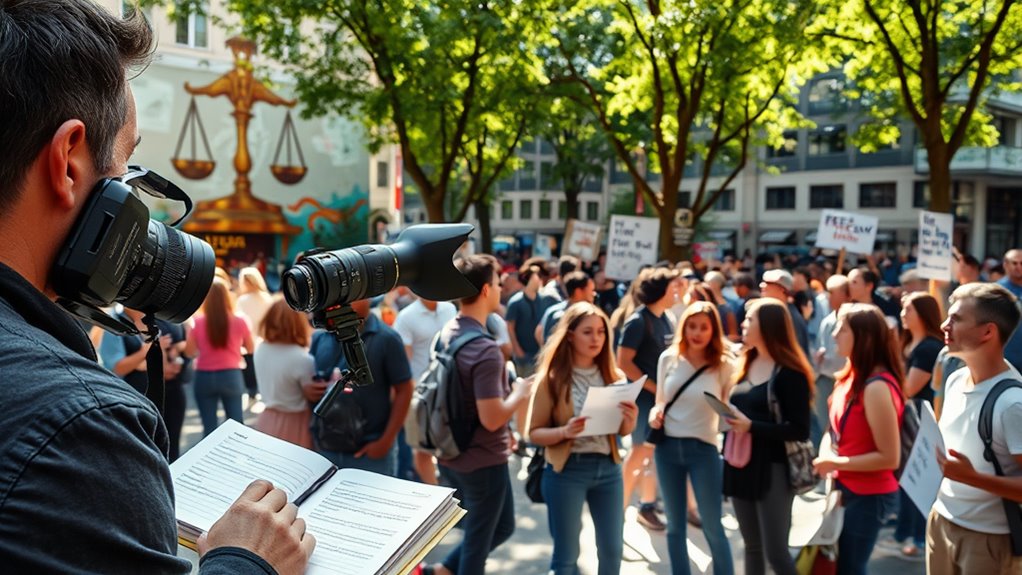
Press freedom is crucial in a democratic society as it keeps citizens informed and engaged. It promotes accountability in governance and enables diverse perspectives to thrive. The press acts as a watchdog, exposing corruption and urging transparency. Informed citizens are empowered to participate actively in their communities, nurturing civic engagement. Nonetheless, challenges such as misinformation and censorship threaten press freedom. Exploring these dynamics reveals the intricate relationship between media, ethics, and democracy.
The Foundation of Democracy: Understanding Press Freedom
Press freedom serves as a cornerstone of democratic societies, guaranteeing that citizens are informed and engaged. This fundamental liberty allows the press to report on issues of public interest without fear of censorship or retaliation. A free press promotes transparency and accountability, enabling citizens to make informed decisions about governance and societal issues.
Understanding press ethics is significant in this situation, as ethical journalism upholds integrity, accuracy, and fairness in reporting. Journalists must adhere to established standards to maintain public trust and guarantee that the information disseminated is reliable.
Moreover, media literacy plays an important role in empowering citizens to critically evaluate news sources and discern fact from misinformation. By cultivating an informed citizenry that values ethical journalism, societies can strengthen democracy and promote active participation. Consequently, the interplay between press freedom, ethics, and media literacy forms the bedrock of a dynamic democratic society.
The Role of the Press as a Watchdog
The press serves as an essential watchdog in democratic societies, ensuring that authority remains accountable to the public. Through investigative journalism, the media exposes corruption and malpractice, nurturing transparency within institutions. This role not only informs citizens but furthermore promotes a culture of integrity and responsibility among those in authority.
Investigative Journalism Impact
Although often underappreciated, investigative journalism serves as a crucial mechanism for accountability in democratic societies. By employing rigorous investigative techniques, journalists uncover truths that might otherwise remain hidden, exposing corruption and malpractice. This form of journalism demands a high level of journalistic integrity, as reporters must navigate complex ethical terrains while ensuring the accuracy of their findings. Investigative journalism not only informs the public but also holds influential entities accountable, nurturing a culture of transparency. Its impact extends beyond mere reporting; it encourages civic engagement and strengthens democratic processes. In a world where misinformation can easily proliferate, the role of investigative journalism becomes increasingly significant, ensuring that citizens are equipped with the knowledge needed to make informed decisions.
Accountability and Transparency
As a dynamic democracy thrives on accountability and transparency, the press functions as an vital watchdog that monitors authority and exposes wrongdoing. This role is significant in holding government officials and institutions accountable, ensuring they operate within the bounds of the law and ethical standards. Through diligent reporting, the media illuminates issues that require public attention, thereby nurturing an informed citizenry. Transparency measures, such as open records and public disclosures, are often advocated by journalists to improve government accountability. By scrutinizing decisions and policies, the press not only informs the public but also promotes civic engagement. In the end, media accountability serves as a cornerstone of democratic society, safeguarding against corruption and advancing the common good.
Empowering Citizens Through Information
Access to diverse perspectives is essential for empowering citizens in a democratic society. When individuals are informed by a variety of viewpoints, they are more likely to engage in civic activities and participate in the democratic process. This flow of information nurtures a well-informed populace capable of making thoughtful decisions.
Access to Diverse Perspectives
How can access to diverse perspectives improve the fabric of a democratic society? It nurtures media diversity and opinion plurality, enabling citizens to encounter alternative narratives. This access improves cultural representation and guarantees that marginalized voices are heard, contributing to inclusive reporting. As a result, critical perspectives emerge, enriching democratic discourse and promoting societal dialogue.
| Aspect | Importance | Examples |
|---|---|---|
| Media Diversity | Guarantees varied viewpoints | Newspapers, podcasts |
| Opinion Plurality | Encourages debate | Editorials, blogs |
| Marginalized Voices | Amplifies underrepresented | Community stories |
| Inclusive Reporting | Reflects societal realities | Diverse sources |
| Information Equity | Equal access to information | Public libraries, internet |
Access to diverse perspectives eventually empowers citizens through robust information equity.
Fostering Civic Engagement
The interplay between diverse perspectives and civic engagement greatly shapes a democratic society. Press freedom plays an essential role in nurturing informed citizenship by ensuring that citizens have access to critical information. This access encourages civic participation and improves voter engagement, leading to greater community involvement. A well-informed public can engage in meaningful public discourse, raising political awareness and supporting grassroots movements and social activism.
- Promotes informed decision-making
- Strengthens community ties
- Encourages active participation in democracy
The Impact of Misinformation on Democracy
Although misinformation has existed in various forms throughout history, its pervasive influence in the digital age poses significant challenges to democratic institutions. The effects of misinformation can lead to confusion, polarization, and in the end, democracy erosion. Citizens, bombarded by false narratives, struggle to discern truth, diminishing their capacity to make informed decisions.
| Misinformation Effects | Impact on Society | Long-term Consequences |
|---|---|---|
| Distrust in media | Erosion of public trust | Weakening of democratic norms |
| Polarized communities | Increased division | Heightened social conflict |
| Misguided policy decisions | Impaired governance | Diminished civic engagement |
As misinformation proliferates, it becomes crucial for societies to address its consequences. A well-informed public is vital for the health of democracy, necessitating robust press freedom to counteract deceptive narratives.
Challenges Facing Press Freedom Today
Though press freedom is a cornerstone of democratic societies, it faces numerous challenges in the modern environment. These obstacles threaten the ability of journalists to operate independently and inform the public effectively.
Key challenges include:
- Censorship tactics employed by governments and organizations to stifle dissenting voices and limit access to information.
- Digital surveillance that compromises the privacy of journalists and their sources, creating a chilling effect on reporting.
- The rise of misinformation, which undermines the credibility of reputable news outlets, making it harder for them to convey accurate information.
Together, these factors create an atmosphere of fear and uncertainty for those involved in the press. As the terrain continues to evolve, it becomes increasingly vital to address these challenges to safeguard press freedom and, by extension, democracy itself.
The Importance of Independent Journalism
Independence in journalism serves as an fundamental pillar for democratic societies, ensuring that diverse perspectives are represented and that authority is held accountable. Independent media plays a significant role in nurturing public discourse, providing citizens with unbiased information necessary for informed decision-making. This independence allows journalists to pursue stories without fear of censorship or retribution, thereby promoting journalistic integrity. When media outlets operate free from external influences, they can investigate issues thoroughly and present facts accurately, which is crucial for maintaining transparency in governance. Additionally, independent journalism acts as a watchdog, exposing corruption and abuse of influence, ultimately contributing to a more just society. In a world increasingly dominated by corporate interests and political pressures, the commitment to independent journalism is more important than ever, as it safeguards democracy and empowers citizens by equipping them with the knowledge they need to engage actively in their communities.
Global Perspectives on Press Freedom
Press freedom varies considerably across the globe, influenced by cultural, political, and historical contexts. In some countries, robust protections allow for lively journalism, whereas in others, restrictive measures stifle dissenting voices. Global initiatives aimed at promoting press freedom seek to address these disparities, nurturing environments where the media can operate independently.
- Cultural influences play a significant role in shaping public attitudes regarding journalism and media regulation.
- Nations with a history of democratic governance tend to uphold stronger press freedoms compared to authoritarian regimes.
- International organizations advocate for press freedom, emphasizing its significance as a pillar of democracy.
Understanding these global perspectives is fundamental for recognizing the diverse challenges and advancements in the area of press freedom. In the end, cultivating a worldwide commitment to independent journalism is imperative for safeguarding democracy and promoting transparency.
Steps to Safeguard Press Freedom in Society
To guarantee that press freedom is effectively safeguarded in society, a multifaceted approach is necessary, incorporating legal protections, public awareness, and institutional support. Legal frameworks must be strengthened to secure the protection of journalists and the media from undue censorship and harassment. Public awareness campaigns can educate citizens on the importance of press freedom and the role of journalism in democracy.
Moreover, enhancing media literacy among the population is vital, enabling individuals to critically evaluate information sources and understand the significance of an independent press.
| Step | Description |
|---|---|
| Legal Protections | Enforcing laws that shield journalists from censorship. |
| Public Awareness | Campaigns to inform citizens about press freedom. |
| Institutional Support | Providing resources to media organizations. |
| Media Literacy | Educating the public on evaluating information sources. |
| Community Engagement | Encouraging dialogue between media and the public. |
Frequently Asked Questions
How Does Press Freedom Differ in Various Countries?
Press freedom varies considerably across countries, influenced by different press regulations and censorship practices. In some nations, media operates with minimal restrictions, nurturing open dialogue and diverse viewpoints. Conversely, other countries impose strict regulations, limiting journalistic expression and controlling information flow. Censorship practices can include government oversight, suppression of dissenting voices, and penalties for reporting unfavorably on authorities, ultimately shaping the terrain of information dissemination and public discourse in each respective region.
What Are the Legal Protections for Journalists?
As the saying goes, "A pen is mightier than the sword." In many countries, legal protections for journalists are established to safeguard journalist rights. These protections can include laws against censorship, shield laws that prevent journalists from revealing sources, and provisions that guard against violence or intimidation. Nevertheless, the extent and effectiveness of these legal protections vary greatly, reflecting broader societal values and the degree of commitment to uphold press freedoms.
How Can Citizens Support Press Freedom Efforts?
Citizens can actively support press freedom efforts through increased public awareness and community engagement. By educating themselves and others about the importance of a free press, individuals can cultivate discussions that highlight its significance. Participating in local events, attending town hall meetings, and advocating for policies that protect journalists are crucial actions. Furthermore, supporting independent media outlets can help guarantee diverse voices are heard, reinforcing the collective commitment to uphold press freedom in society.
What Are the Consequences of Press Censorship?
Press censorship leads to significant consequences, undermining the integrity of information available to the public. It encourages media manipulation, where narratives are controlled to serve specific agendas, resulting in a misinformed populace. The lack of diverse viewpoints can stifle critical thinking and debate, diminishing societal progress. Moreover, censorship can create an environment of distrust, as citizens become unaware of crucial issues, eventually weakening the foundations of informed decision-making within a community.
How Does Social Media Impact Traditional Press Freedom?
In a world where social media reigns supreme, traditional journalism often feels like a relic from a bygone era. The dynamics of social media dramatically reshape how news is consumed and shared, often prioritizing speed over accuracy. This shift can undermine the integrity of traditional press freedom, as sensationalized content competes for attention. In the end, the rise of social media presents both challenges and opportunities for traditional journalism, demanding adaptation and resilience.